
Fields in Staunton Property Tax Records
Assessment and collection sit in separate hands in Staunton. The City Assessor's land book carries the owner name, legal description, PID, assessed value, and the tax levied for that year. The Treasurer's office runs the real-estate tax account and takes the payment. Keep the source attached to each figure. An assessed value is only the tax basis. A levy is a charge. Payment status lives in the account record. Treat the yearly land book as a research aid, and take any current balance question straight to the Treasurer.
| Field | What It Shows | Where |
|---|---|---|
| Assessed value | Value carried on the assessor roll for the stated year | City Assessor |
| Land-book levy | Tax charge recorded with the yearly parcel entry | City Assessor |
| Real-estate tax bill | Installment amount and account balance | City Treasurer |
| Payment status | Whether an account payment is recorded | Treasurer's tax service |
| Relief or exemption | Program status where applicable; confirm eligibility with the city | Assessor / Treasurer guidance |
A tax record is not a price record. Virginia law aims general assessments at 100 percent of fair market value. But a mass assessment remains a tax figure pinned to one date and one method. A deed may state consideration. A later sale can land far from the assessed value. To read the numbers cleanly, hold three things apart. Keep the assessment year, the levied charge, and the payment account separate. The Staunton property value guide walks through the valuation distinction in more depth.
Find the Staunton Tax Account and Bill
Staunton's Citizen Self Service site is the online door for real-estate tax billing and payment. The public entry page offers a guest route along with account access. Start from the current official page, search with the address or account details it requests, and confirm the parcel before paying. A name alone may not separate two similar accounts. When a balance, credit, or prior payment looks wrong, call the Treasurer at 540-332-3833 with the property address and account reference in hand.
- Open the city's Citizen Self Service real-estate tax page.
- Choose the available guest or account route and enter the requested address or account reference.
- Confirm the displayed parcel and installment before paying; save the confirmation for your own records.
- Ask the Treasurer about a disputed balance, missing payment or older account history.
- Assessed value
- The roll value used to calculate the real-estate tax.
- Levy
- The tax charge shown for the parcel and year.
- Relief program
- A city-administered reduction or assistance program with its own current rules.
- Delinquent account
- A balance the Treasurer reports as unpaid after its due date; confirm the status with that office.
Staunton's Two-Installment Tax Calendar
Staunton splits its real-estate tax bill across two due dates: June 20 and December 5. Three-quarters of the annual charge comes due in June. The final quarter lands in December. Those dates belong to the bill itself, not the assessment year. Keep both in view when reviewing an account. Payments near a deadline are worth confirming with the Treasurer's current page or a call to the office. Ask about accepted channels, posting times, and the balance owed.
Payment runs five ways. Go online through Citizen Self Service, by phone, at the City Hall counter, in the drop box, or by mail. The mailing address is P.O. Box 474, Staunton, VA 24402-0474, and the counter is open 8:30 a.m. to 5 p.m. For tax help, call 540-332-3833. Skip payment links that arrive in unexpected messages. Go to the city's own tax page or call the Treasurer instead. The Staunton Citizen Self Service tax entry is the online route.
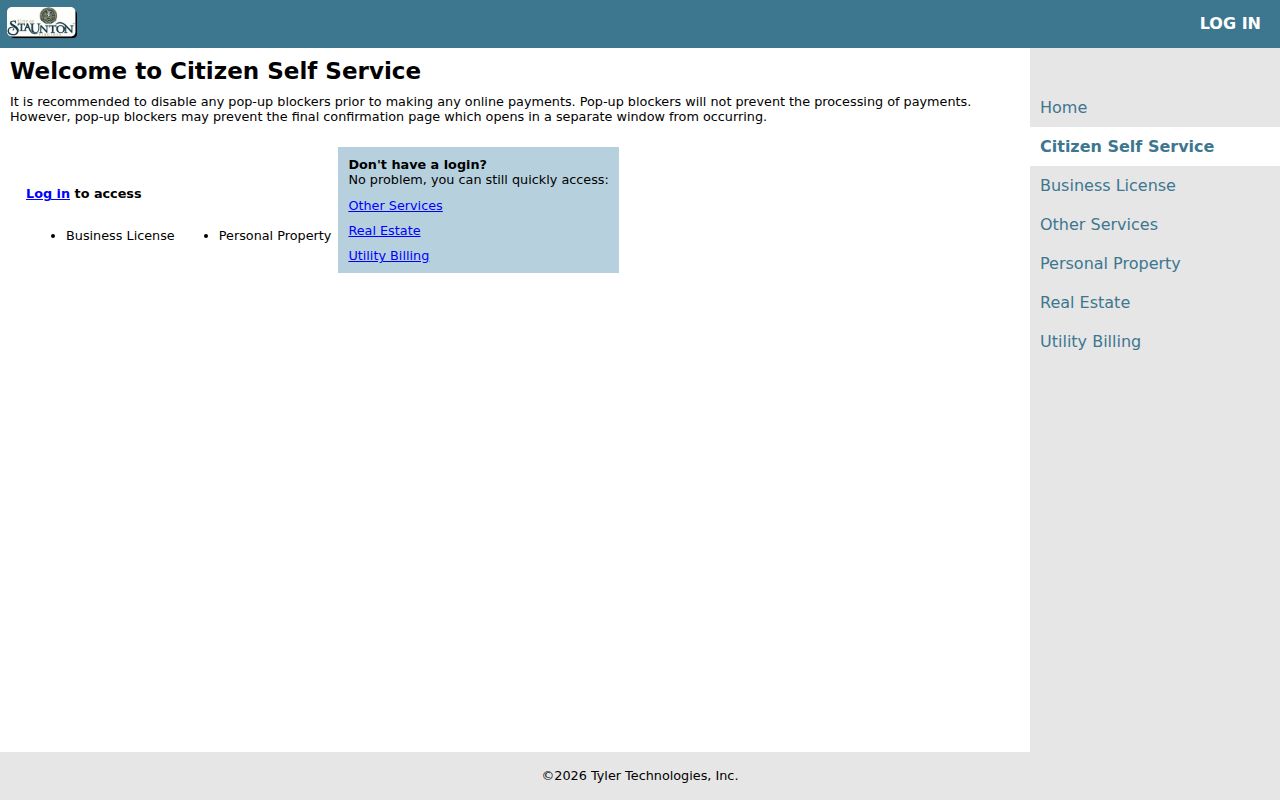
The Citizen Self Service page is only an entry point. Use the account screen and the Treasurer for live payment status.
Appeal a Staunton Assessment With Parcel Evidence
A Staunton assessment appeal can move through more than one stage. The Assessor's appeal process lays out the grounds and materials for asking the city to re-examine an assessment, and the Board of Equalization stands as a separate route after that review. Strong appeals name the parcel and the exact problem, whether a comparable sale, a property characteristic, an acreage difference, or a factual error on the card. Evidence should match the assessment date, because a later sale or improvement may not describe the property's value as of the date under review.
Deadlines illustrate how the calendar works rather than promising a fixed schedule: the assessor page listed March 23, 2026 as its appeal deadline, with a Board of Equalization session on April 23, 2026 and no walk-ins per the Board notice. Confirm the current year's notice, form, and appointment instructions before filing. The Assessor's contact number is 540-332-3827, and the appeal page lists weekday hours of 8 a.m. to 5 p.m.
Appeal window. Assessment deadlines change by year. Use the current Staunton Assessor notice and Board of Equalization instructions; do not treat a past 2026 date as this year's deadline.
Staunton's Reassessment Years Are Two Years Apart
Staunton reassesses general property values every two years. The last general reassessment took effect January 1, 2025, making 2026 an off year. The next general cycle is scheduled for January 1, 2027. Off years still see changes. These can come from new parcels, acreage adjustments, construction, or other qualifying events. A 2026 value can therefore reflect a property-specific event without any citywide revaluation behind it.
Read an assessment notice carefully. Keep the effective date and the reason for the change in mind. The city's 2025 notices state that market conditions, not city project needs, drive assessment changes. For the proposed FY2027 budget, the city listed a real-estate rate. That rate was $0.91 per $100 of assessed value. Confirm the adopted rate before relying on it in a current calculation. The final bill also depends on the parcel's charge and any relief applied.
Staunton Tax Relief Has Its Own Application Rules
Staunton publishes tax-relief guidance for elderly and disabled residents, with eligibility rules and an application process set out in the city's current guidelines rather than in any fixed income, age, or asset threshold stated here. May 1 appears in the guidance as an application date, so check the current packet and year before counting on that deadline. A relief decision affects only the tax program. It does not change the deed or the parcel's assessed market value.
Owners can reach the Treasurer's tax-assistance line at 540-332-3833 or contact the Assessor about the value record. When a tax bill looks inconsistent, confirm whether a relief program was approved and whether the account screen reflects it. Never infer eligibility from age, disability status, or an older application; the city's current rules control.
Delinquent Tax and Sale Details Need a Direct Request
Staunton publishes no public portal for delinquent-tax sales, and no searchable list of sale parcels appears among the city's offerings either. For an unpaid balance, start with the Treasurer. When you need a lien record, payment history, or sale file, identify the parcel and the date range, then ask the custodian what existing records can be inspected. A VFOIA request should seek a specific existing record. It cannot demand a new analysis or custom list.
Never treat a search result or a general tax notice as proof that a parcel is scheduled for sale. That notice is not the record. Ask the Treasurer whether an account is delinquent. Ask the Circuit Court Clerk whether a related land instrument has been recorded. Staunton tax records and land records can show different pieces of the same matter, and the custodian can point you to the office holding the next document.
Use the Staunton Land Book When the Portal Is Hard to Reach
The Assessor posts yearly land-book PDFs. Both the 2025 and 2026 editions are linked. The 2026 book carries an unofficial-copy label, so treat it as a handy offline route rather than certified proof. Each parcel line shows the owner, legal description, PID, assessed value, and levied tax amount. Keep the book year attached to any copied entry. The land book can lag behind a new recording, so compare recent transfers with the Clerk's deed index.
The land book never replaces a current tax-account balance or receipt. For Staunton property tax records, use the Assessor's book to understand the roll. The Treasurer establishes what is due or paid. If a parcel line is missing from the PDF, ask the city office for the proper inspection or copy route. Do not assume the owner has no tax record.